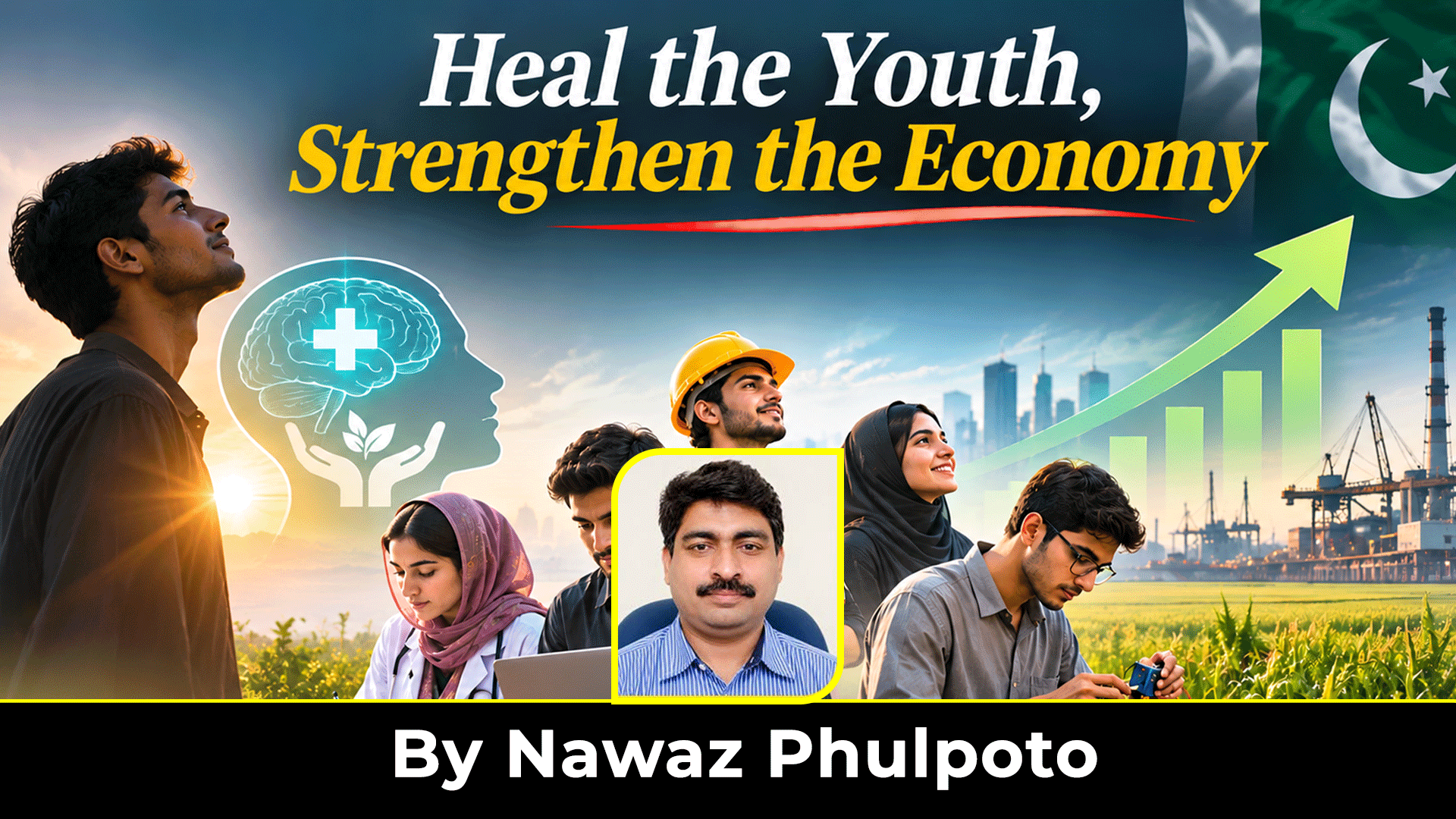
Pakistan’s greatest economic resource is not its minerals, agricultural land or geographical location; it is its young population. However, this demographic advantage can only translate into economic prosperity when young people are mentally healthy, emotionally resilient, skilled and capable of contributing productively to society. An often-neglected dimension of youth development is psychological healing.
Across Pakistan, thousands of young people are navigating unemployment, poverty, family pressures, educational uncertainty, social exclusion, violence and an increasingly complex digital environment. For many, these challenges are not simply temporary difficulties; they leave emotional scars that affect confidence, decision-making, relationships and their ability to participate meaningfully in economic life.
The scale of this challenge is particularly concerning when viewed through the lens of youth mental health and suicidal tendencies. A 2023 study involving 401 university students in Sindh reported that 27.2 per cent of respondents experienced serious suicidal thoughts, while 11.7 per cent reported having attempted suicide. Although these findings are based on a limited university sample and cannot be generalised to all young people in Pakistan, they provide an important warning about the psychological distress experienced by sections of the country’s educated youth.
Another forensic study conducted in Faisalabad between 2019 and 2023 identified 82 suicide deaths, with young adults aged 20–29 representing the predominant age group. Furthermore, an online survey of 5,365 Pakistani respondents, conducted between June 2021 and March 2022, reported suicidal ideation among 45.7 per cent and suicide attempts among 9.9 per cent of participants. These findings should be interpreted cautiously because the survey was not nationally representative and did not exclusively examine young people.
Pakistan also lacks a comprehensive, reliable national system for recording suicide deaths, attempts and suicidal thoughts separately by age group. Underreporting, social stigma and inadequate surveillance make the actual scale of the problem difficult to establish. Nevertheless, the available evidence is sufficiently concerning to demand a coordinated national response.
The question, therefore, is not only how to educate and train young people, but also how to heal, empower and prepare them to become productive citizens.
Economic development policies generally emphasise education, vocational training, entrepreneurship and employment generation. These interventions are essential, but they may fall short when the individuals they target are struggling with unresolved psychological distress.
A young person experiencing trauma, chronic stress, anxiety or hopelessness may find it difficult to concentrate, acquire new skills, maintain employment or establish a business. Similarly, young people exposed to domestic violence, community conflict, displacement, discrimination or extremist influences may develop mistrust, anger and a sense of alienation.
Ignoring these realities can undermine investments in education and skills development. Training a young person without addressing the emotional barriers affecting their motivation and confidence is like building a structure without strengthening its foundation.
Healing therapy, therefore, should be recognised as an important component of youth development and economic empowerment.
Another troubling dimension of Pakistan’s youth crisis is the involvement of young people in criminal cases, including those who are nominated as accused, detained as under-trial prisoners or declared absconders by the relevant authorities.
Pakistan’s National Prison Data Report 2024 recorded 1,584 juveniles imprisoned across the country, approximately 85 per cent of whom were awaiting trial. Sindh’s State of Children in Pakistan 2024 report separately documented 1,362 children in juvenile detention institutions, including 1,178 under-trial and 184 convicted children.
The challenge extends beyond prison populations. Sindh Police recorded a cumulative balance of 48,516 absconders at the end of 2024, rising to 51,422 at the end of 2025. These figures cover all age groups and do not establish how many are young people. Nor should an accused person or absconder automatically be considered a convicted criminal.
Nevertheless, these figures highlight the wider criminal justice challenge and raise an important question: how many young people could be prevented from entering cycles of criminal behaviour through timely psychological support, family counselling, education, mentorship and economic opportunities?
Unemployment, poverty, family instability, substance abuse, social exclusion and negative peer influences can expose vulnerable young people to criminal exploitation and destructive behaviours. Psychological distress alone does not cause criminality, but unresolved adversity combined with limited opportunities can increase vulnerability.
A young person entering the criminal justice system should not automatically be viewed as a lost cause. Particularly in cases involving juveniles, rehabilitation, education, psychosocial support and opportunities for reintegration must remain central to the response.
Pakistan needs to complement its law-enforcement and criminal justice efforts with preventive youth development interventions. The objective should not be to excuse criminal behaviour, but to identify vulnerability early, prevent recruitment into criminal networks, rehabilitate young offenders and provide pathways towards responsible citizenship.
Every young person diverted from a life of crime and supported towards education, skills and employment represents not only a social achievement but also a potential economic contributor.
Healing does not simply mean treating mental illness. It also involves helping young people recover from distressing experiences, rebuild self-confidence, develop emotional intelligence, strengthen social relationships and regain a sense of purpose.
Through counselling, psychosocial support, peer-group engagement, creative expression, sports, mentorship, community participation and trauma-informed interventions, young people can develop the emotional resilience needed to navigate life’s challenges.
These interventions can produce tangible economic benefits. A psychologically supported young person is better positioned to complete education, benefit from vocational training, maintain workplace relationships, pursue entrepreneurship and contribute to community development.
For example, a young person who has experienced violence or prolonged social exclusion may struggle to trust others or participate in collective activities. With appropriate psychosocial support, mentorship and opportunities for positive engagement, that individual may gradually regain confidence and become an active member of society.
Pakistan needs to move beyond viewing vulnerable young people exclusively through the lens of unemployment, poverty or security concerns. They should instead be seen as individuals with untapped potential who require the right combination of emotional support, education, skills and economic opportunities.
First, psychological healing: Establish accessible counselling and psychosocial support services in schools, colleges, universities, vocational training centres and communities. Special attention should be given to young people affected by violence, displacement, family instability, social exclusion and suicidal distress. Early identification, professional assessment and referral mechanisms must be integral to these services.
Second, skills and economic empowerment: Connect psychosocial interventions with vocational training, digital literacy, technical education, entrepreneurship and job placement. Healing should open the door to opportunity, while economic participation should reinforce confidence and independence.
Third, social connection and positive engagement: Encourage sports, arts, volunteerism, cultural activities, community service and youth-led initiatives. These platforms can rebuild trust, promote social cohesion and provide constructive alternatives to isolation, violence and destructive influences.
Fourth, mentorship and life skills: Engage teachers, psychologists, social workers, business professionals and community leaders to guide young people in developing leadership, communication, conflict resolution, problem-solving and financial management skills.
Such an integrated approach would help bridge the gap between psychological well-being and economic productivity.
The Government of Pakistan, provincial governments, educational institutions, technical training authorities and development organisations should recognise youth healing as an integral part of human capital development.
Provincial skills development programmes could introduce basic psychosocial screening, referral mechanisms and trained counsellors alongside vocational training. Universities and colleges could establish youth wellness and counselling centres, while community-based organisations could facilitate peer-support networks and structured rehabilitation activities.
Public-private partnerships can further strengthen this approach by connecting psychologically supported and skilled young people with internships, apprenticeships, employment and entrepreneurship opportunities.
Importantly, these programmes must be inclusive, culturally sensitive and professionally supervised. Mental health support should not be reduced to motivational speeches or occasional recreational activities. Young people experiencing serious psychological difficulties need qualified professionals, confidentiality and appropriate referral services.
Pakistan should also develop a national suicide prevention and surveillance framework, including age-disaggregated data, confidential reporting mechanisms, accessible crisis-support services and evidence-based prevention programmes in educational institutions.
Programme outcomes should be measured through meaningful indicators, including educational retention, training completion, employment, entrepreneurship, social participation, successful rehabilitation and improvements in psychological well-being.
Pakistan’s demographic dividend will not automatically become an economic dividend. A large youth population can become a powerful engine of growth only when supported by education, health, skills, dignity and opportunities.
The country cannot afford to lose the potential of millions of young people to untreated psychological distress, hopelessness, social alienation, criminal exploitation and exclusion. Nor can it expect vocational certificates alone to resolve challenges rooted in trauma and prolonged adversity.
We must begin to understand that economic empowerment is not exclusively about providing jobs, loans or technical skills. It is equally about restoring the confidence, motivation and emotional strength that enable individuals to seize those opportunities.
A healed young person can become a skilled worker, an innovative entrepreneur, a responsible professional, a community leader and a contributor to national development.
Pakistan must therefore invest not only in training its youth to earn, but also in healing them to grow, participate and prosper. Because the road to a stronger economy begins with the well-being of its people, and particularly its young generation.
The Author is a freelance writer and Youth Development Expert and can be reached at nawazphulpoto@yahoo.com