Pakistan’s struggle against violent extremism is often examined through the lens of terrorism, militancy, intelligence operations and law enforcement. While these dimensions remain critical, another equally important factor deserves greater attention: political instability. The relationship between political instability and violent extremism is complex, but its implications for Pakistan’s national security, democratic governance and social cohesion are significant.
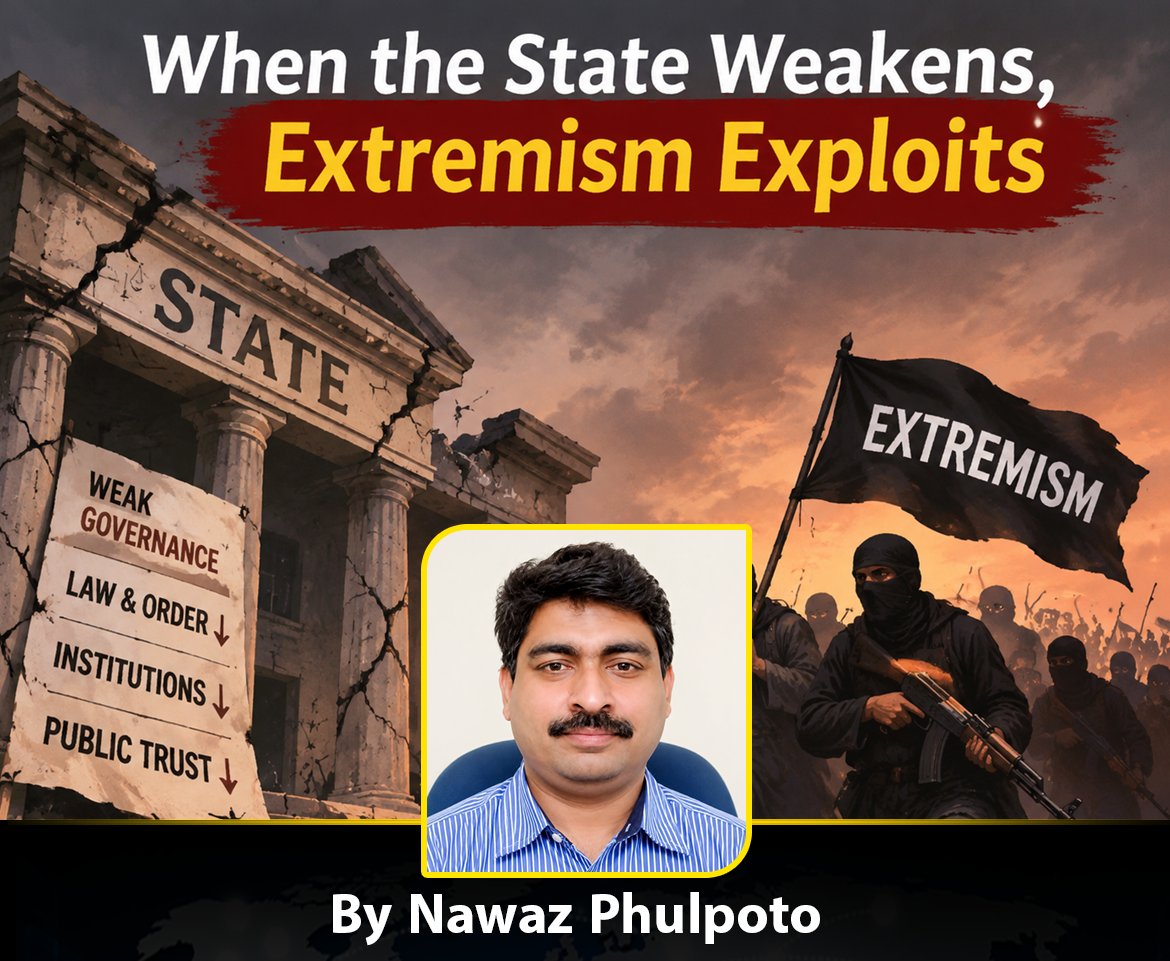
Political instability does not automatically produce violent extremism. However, prolonged political uncertainty, institutional confrontation, governance failures and declining public confidence can create an environment that extremist organizations may exploit. When citizens begin to lose confidence in political institutions and peaceful mechanisms of change, extremist narratives can find opportunities to gain traction, particularly among socially and politically marginalized communities.
Pakistan’s political landscape has experienced considerable turbulence in recent years. Political polarization, contested electoral processes, confrontation among political stakeholders and uncertainty surrounding institutional relationships have contributed to an environment of public distrust. Such developments have consequences beyond parliamentary politics. They can weaken the credibility of institutions, distract national leadership from long-term policy priorities and create opportunities for non-state actors to challenge the authority of the state.
One of the most significant connections between political instability and violent extremism is the erosion of institutional legitimacy. The legitimacy of a state depends not merely on its capacity to exercise authority but also on public confidence in its institutions, fairness of its legal system and responsiveness to citizens’ concerns. When sections of society perceive political processes as exclusionary or institutions as unaccountable, their trust in constitutional and democratic mechanisms may decline. Extremist organizations can exploit these perceptions by promoting narratives that portray the state as unjust, ineffective or disconnected from ordinary citizens.
Political polarization further complicates this challenge. In a deeply divided political environment, disagreement can gradually transform into hostility, intolerance and the demonization of opposing viewpoints. Social media platforms can intensify this process through misinformation, inflammatory messaging and conspiracy narratives. Although political disagreement is a legitimate feature of democratic societies, the normalization of hostility and violence can weaken the broader culture of tolerance. Extremist actors may exploit this atmosphere to promote ideological intolerance and justify violence.
A second important dimension is the relationship between weak governance and extremist expansion. Political instability frequently disrupts administrative continuity, policy implementation and institutional coordination. When governments remain preoccupied with political survival and confrontation, essential governance priorities may receive insufficient attention. Local administration, education, healthcare, employment generation and community-level security mechanisms can suffer as a result.
This problem is particularly relevant to vulnerable areas of Khyber Pakhtunkhwa and Baluchistan, where historical governance deficits, insecurity, political grievances and limited development opportunities have created complicated security challenges. In such environments, militant organizations may attempt to exploit administrative weaknesses, intimidate local populations and establish alternative structures of authority. Their influence, however, should not be confused with genuine public representation or legitimate political grievances.
Political exclusion is another important factor. Communities that perceive themselves to be politically marginalized, economically neglected or deprived of meaningful representation may develop a sense of alienation from the state. In Baluchistan, for example, concerns relating to political representation, resource distribution, missing persons and human rights have remained important subjects of public debate. Similarly, the former tribal districts of Khyber Pakhtunkhwa continue to face challenges associated with governance, security and development.
It is essential to distinguish between legitimate grievances expressed through peaceful and constitutional means and the violent activities of extremist or militant organizations. Addressing grievances through political dialogue, accountability and institutional reform is not a concession to extremism; rather, it is an essential element of preventing violence.
The socioeconomic dimension also requires serious consideration. Pakistan has a substantial young population, representing both an important national asset and a significant policy responsibility. Unemployment, inadequate educational opportunities, limited access to skills development and the absence of meaningful economic prospects can increase vulnerability to exploitation. Poverty alone does not cause radicalization, and the majority of unemployed or economically disadvantaged young people do not turn towards violence. Nevertheless, extremist recruiters can manipulate frustration, identity crises and feelings of injustice by offering financial incentives, belonging, recognition and a seemingly purposeful identity.
This is where youth development must become an integral part of Pakistan’s prevention strategy. Technical and vocational education, entrepreneurship, digital literacy, career counselling and meaningful civic engagement can strengthen young people’s resilience against extremist recruitment. Equally important is creating spaces where young people can express grievances, participate in public decision-making and contribute positively to their communities.
Another critical concern is the weakening of the social contract between citizens and the state. This relationship is founded on mutual responsibilities: the state is expected to provide security, justice, equal rights and opportunities, while citizens recognize its constitutional authority. When citizens experience unequal treatment, selective accountability or a lack of access to justice, confidence in this relationship can deteriorate. Extremist organizations may then exploit the resulting discontent by presenting themselves as alternative providers of justice, protection or identity.
Political uncertainty can also affect the operational capacity of counterterrorism institutions. Disagreements over national priorities, inconsistent policies and weak coordination can undermine sustained security responses. Counterterrorism requires continuity, institutional cooperation and political consensus. It cannot remain effective if national security priorities repeatedly become secondary to political confrontation.
Pakistan’s increasing security challenges in recent years demonstrate the urgency of addressing these interconnected factors. However, responding to militancy exclusively through security operations would overlook the broader political, economic and social conditions that extremist organizations exploit. Counterterrorism operations may disrupt militant networks, but sustainable prevention requires reducing the vulnerabilities that enable recruitment and radicalization in the first place.
Pakistan therefore needs a comprehensive approach that integrates three interconnected dimensions. The first is hard security, including intelligence coordination, professional law enforcement, border management and effective counterterrorism operations. The second is soft prevention, encompassing education, community engagement, counter-narratives, youth empowerment, rehabilitation and reintegration. The third, and perhaps the most fundamental, is structural prevention, which requires inclusive governance, institutional accountability, political participation, equitable development and the strengthening of the rule of law.
The role of educational institutions, civil society, religious scholars, media organizations and local communities is equally important. Countering violent extremism cannot be the exclusive responsibility of security agencies. It requires a whole-of-society approach in which credible community voices promote tolerance, critical thinking, peaceful coexistence and respect for constitutional values.
Pakistan’s experience suggests that security and political stability cannot be treated as separate policy concerns. A state may possess considerable coercive capacity, but lasting peace also depends on public trust, institutional credibility and citizens’ belief that their grievances can be addressed through peaceful and democratic means.
Ultimately, the challenge of violent extremism in Pakistan is not simply about confronting those who resort to violence; it is also about strengthening the political, institutional and social environment in which violence becomes less attractive and less possible. Political stability, inclusive governance and a renewed social contract are therefore not merely democratic aspirations. They are essential components of a sustainable national strategy for preventing violent extremism.
The author is a Defense Strategic Analyst and can be reached at nawazphulpoto@yahoo.com
Disclaimer: The views and opinions expressed in this article are solely those of the author and do not necessarily reflect the official policy or position of this publication. The article is published for informational and analytical purposes only. The publication does not endorse or support any form of extremism, militancy or violence.