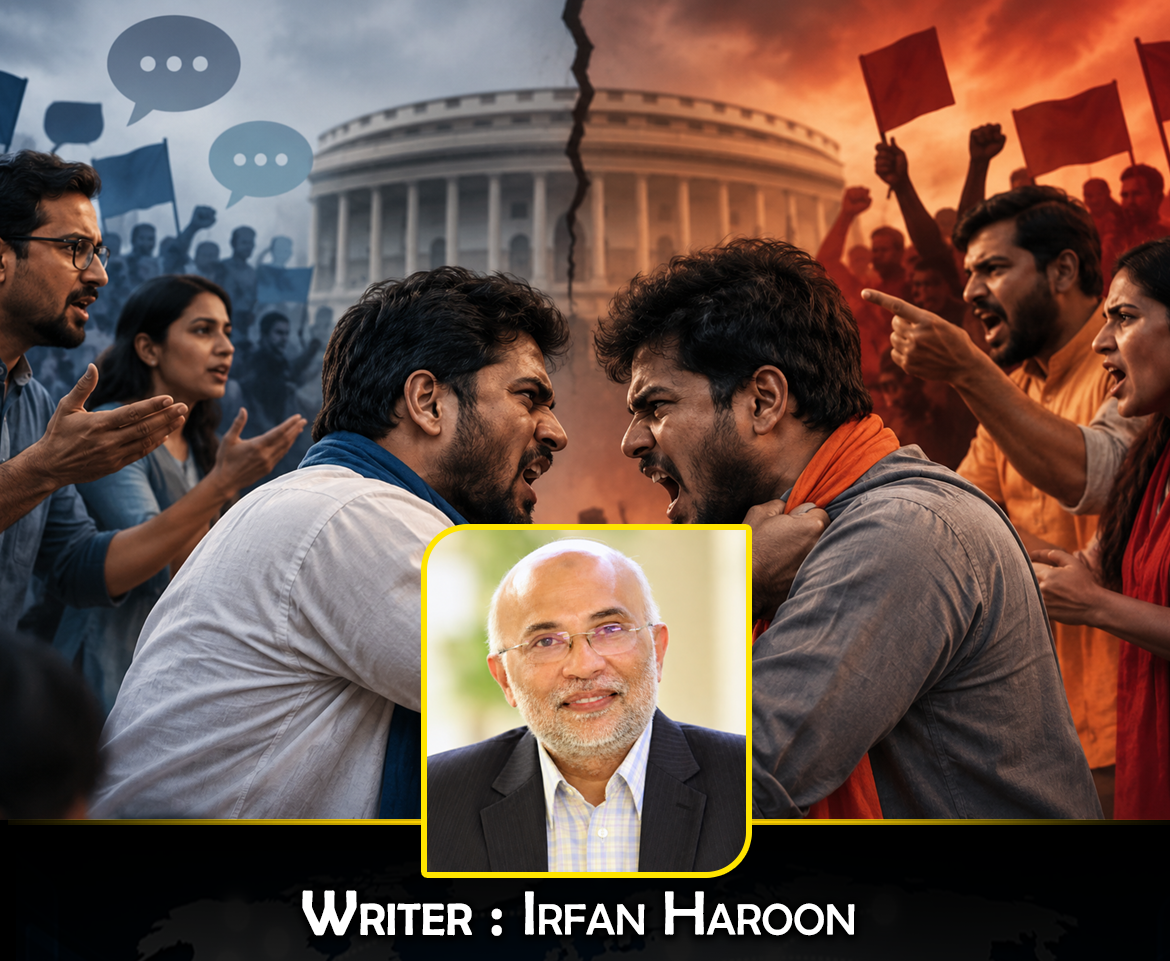
Difference of opinion is a fundamental characteristic of any vibrant, conscious and democratic society. Wherever people with different minds, different experiences and different points of view exist, there will be disagreement, questions will be raised, decisions will be criticised and governments will be held accountable. In fact, the beauty of democracy lies precisely in the fact that everyone does not think alike. The problem is not disagreement itself; the problem arises when disagreement turns into hostility, argument gives way to accusation, criticism becomes character assassination, and political and social discourse descends into abuse, ridicule and hatred.
Today, in Pakistan as well as in many societies around the world, the tone of political discourse appears considerably more bitter than before. Social media has given every individual a platform for expression through which an idea can reach thousands or even millions of people within seconds. But this speed has also raised a fundamental question: are we talking to one another more, or are we listening to one another less?
The significance of this question has increased in Pakistan because the digital world has now become a major part of society. According to the Digital 2026 Pakistan report, by the end of 2025, approximately 117 million people in Pakistan were using the internet, while by October 2025, the country had around 79.9 million social media users, equivalent to approximately 31.2 per cent of the total population.
If these figures are compared with those recorded at the beginning of 2025, the situation becomes even clearer. According to the Digital 2025 Pakistan report, the number of social media users stood at approximately 66.9 million at the beginning of the year. That figure rose to around 79.9 million during the same year. This is not merely a matter of technological expansion; it is also an indication that a substantial part of political, social and national discourse is now taking place in the digital sphere.
SOCIAL MEDIA AND POLITICAL DISCOURSEThis is where the real problem begins. Social media has certainly democratised expression, but it has not made every expression responsible. One person makes an allegation against a political leader or party without verification; another immediately shares it; a third adds an even harsher comment; and before long, an unverified claim takes on the appearance of political reality. A verdict is reached before evidence is presented, and an opinion is formed before facts are investigated.
Recent research into political polarisation and the role of social media in Pakistan also points towards this situation. A study published in 2026 examined political polarisation and political affiliations on social media in Pakistan and identified the emergence of distinct online circles and visible political alignments among different political groups.
This does not mean that political disagreement is new to Pakistan. Our political history has witnessed bitter conflicts between governments and opposition parties before. Political parties have fiercely criticised one another, harsh language has been used at public rallies, and heated debates have taken place in parliament. The difference today, however, is that such political bitterness no longer remains confined to rallies, newspapers or parliamentary chambers. Through mobile phones, it enters every home, every office, every educational institution and the personal lives of individuals.
As a result, political disagreement sometimes becomes part of a person’s identity. If someone supports a particular political party, those who disagree with him or her are no longer seen merely as political opponents; they may instead be labelled bad, traitorous, corrupt, ignorant or anti-national. The opposing group responds with the same intensity. In this way, politics moves away from a contest of policies and ideas and turns into a battle between personalities and groups.
HAVE WE FORGOTTEN TOLERANCE?Here, we must ask ourselves: have we forgotten how to tolerate differences of opinion?
Interestingly, this is not a problem unique to Pakistan. In an international research study published in April 2026, data collected from 15,202 people across 30 countries on six continents was examined. According to the study, people living in less democratic societies and societies with lower levels of economic equality reported experiencing greater online political hostility. It also found that individuals who displayed aggressive political behaviour online were more likely to exhibit aggressive behaviour towards opponents in real life.
This finding is highly significant because it suggests that social media does not automatically make societies more bitter; rather, there is a deep connection between online behaviour and the real political and social environment. Where distrust, economic anxiety, political instability and a crisis of confidence in institutions are more pronounced, social media can become a vehicle that further intensifies these sentiments.
A GLOBAL CHALLENGEEven the world’s major democracies are not immune to this problem. In the United States, political polarisation, electoral conflicts and deep emotional divisions between opposing political groups have become persistent subjects of concern. Britain and Europe, too, have witnessed intense disagreements over issues such as Brexit, immigration, the economy, national identity and foreign policy. It would therefore be incorrect to suggest that politics in other countries has always remained civil while politics in Pakistan has always been bitter.
The more important question is: to what extent can institutions, political traditions, the media and society transform disagreement into a dialogue that remains within the bounds of tolerance?
THE REAL LESSON FOR PAKISTANThis is the real lesson for Pakistan.
It is neither possible nor necessary to eliminate disagreement. In a strong democracy, the opposition questions the government, the government defends its decisions, the media seeks answers from both sides, and the people make their choice through their votes. But when the government and opposition begin to regard each other as enemies, and when political workers start believing that praising their own party and humiliating their opponents is the essence of politics rather than listening to arguments, the democratic process begins to weaken.
Social media has made this problem even more complicated because anger often travels faster than reason. An inflammatory headline, a sarcastic video, a humiliating image or an accusation-based post can reach thousands of people within hours. By contrast, a balanced, well-researched and carefully argued piece may not receive the same immediate attention. Thus, in the race for visibility, bitterness itself can sometimes become a communication strategy.
WHEN MISINFORMATION FUELS EMOTIONThis situation is also closely linked to the problem of misinformation. During the military conflict between Pakistan and India in May 2025, fake images, old videos and artificially generated content circulated widely on social media. One analysis found that of 427 concerning posts examined on X, only 73 had received warning labels, while some posts had been viewed nearly 10 million times.
This example demonstrates that when political and national emotions combine with misinformation, the problem goes far beyond verbal abuse. False information can influence public opinion, national sentiment and even tensions between states. Therefore, in today’s political discourse, it is not enough to ask only what someone is saying; it is equally important to ask whether what is being said is actually true.
THE ROLE OF THE MEDIAThis is where the role of the media becomes extremely important. The purpose of journalism is not merely to broadcast two opposing statements from the government and the opposition. The real task of journalism is to help the public understand what lies behind a claim, what the data says, what the context is, and what evidence exists in support of a particular position.
If political talk shows on television give more time to shouting, interrupting one another, accusations and personal attacks than to reasoned argument, viewers too may begin to regard such behaviour as normal political discourse. Similarly, if immediate reaction rather than journalistic principles becomes the measure of success on social media, the distinction between news and opinion, and between fact and rumour, becomes increasingly blurred.
However, it would also be wrong to place the entire responsibility for this situation on politicians or the media. Ordinary citizens are also part of this environment. Every time we forward a post without reading it, repeat an allegation without evidence, or abuse someone simply because of his or her political affiliation, we are contributing to the political environment in which we live.
LEARNING THE ETHICS OF DISAGREEMENTEducational institutions also have a fundamental role to play. Young people need to be taught not only academic knowledge but also the ethics of disagreement. They must understand that the purpose of a debate is not to silence an opponent but to present one’s position with reason and evidence. Holding a different political view is not, in itself, evidence of ignorance or bad faith.
The same kind of education is necessary at home. If children see their elders ridiculing one another over every political disagreement, they will learn that disagreement means putting the other person down. Conversely, if the environment at home conveys the message, “We disagree with this political party, but we respect its supporters,” the younger generation can learn a more balanced political culture.
We must also make a clear distinction between strong criticism and bad manners. Calling a government policy a failure is a political right. Raising tough questions about a decision is a journalistic responsibility. Proving a political leader’s claim to be wrong is part of the democratic process. But humiliating someone, targeting their family, making false allegations or treating an opponent as inferior as a human being is not disagreement; it is a failure of political and social ethics.
THE REAL QUESTION: HOW DO WE DISAGREE?Ultimately, the question is not why there is disagreement in Pakistan. There should be disagreement. The real question is: how do we disagree?
Do we respond with reason or abuse? Do we answer an opponent’s question or attack his or her intentions? Do we have the courage to question even the political leaders we support? Can we admit when we are wrong? And can we sit with someone whose political views differ from our own? If the answer to these questions is no, then the problem is not merely political; it is also a reflection of our collective social upbringing.
Pakistan perhaps needs a new political dialogue today more than it needs a new political slogan. A dialogue in which tough questions can be asked without rudeness, profound disagreement can exist without hostility, criticism can be expressed without character assassination, and political competition can take place without deepening national divisions.
The experience of the world tells us that political polarisation is not a problem that can be solved by eliminating disagreement. The solution lies in teaching society to tolerate differences, ensuring that institutions remain impartial, encouraging the media to act responsibly, enabling political leadership to set a better example for its workers, and urging citizens to verify information before passing it on.
DISAGREEMENT IS THE BEAUTY OF DEMOCRACYThe beauty of democracy does not lie in everyone thinking alike. Its true beauty lies in people with different ways of thinking being able to live together in the same society while respecting one another’s differences.
We must decide whether we will turn differences of opinion into a democratic strength or continue weakening our collective strength by turning them into hostility. Because when dialogue ends, disagreement becomes enmity; and when disagreement becomes enmity, society begins to be driven not by reason but by emotion.
And perhaps what Pakistan needs most today is to learn once again how to talk to one another and, even more importantly, how to listen to one another.
“Difference of opinion is the beauty of a society; enmity is its weakness. Reason is the path that brings hearts and minds closer, while abuse and accusation widen the distance between them. Before seeking to defeat an opponent, we must try to understand him, because not every disagreement is treason and not every opponent is an enemy. In a democracy, ideas should clash, not people. Politics should be about competition, not hatred; questions, not ridicule; and disagreement, but always with respect. For where dialogue remains alive, hope remains alive too.”