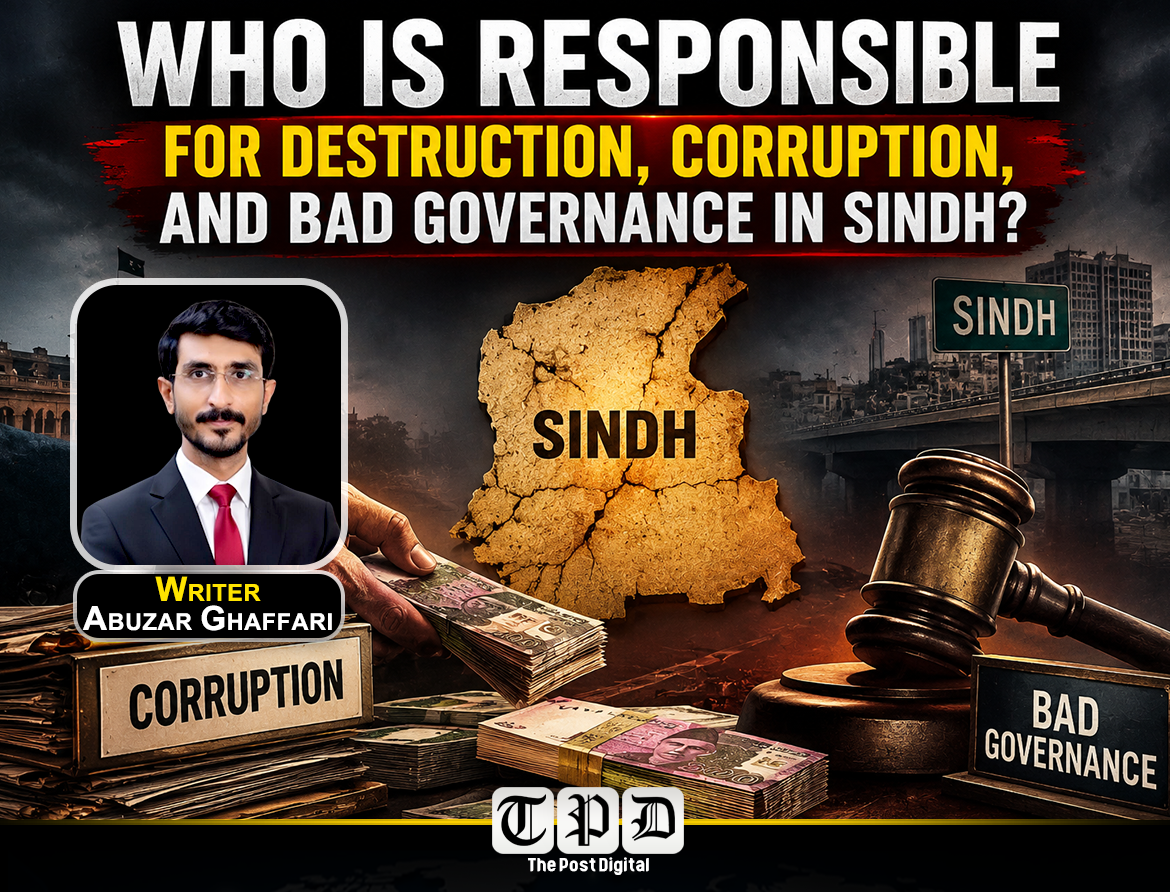
Karachi, Pakistan’s largest economic hub, and the resource-rich province of Sindh continue to face fundamental challenges in education, healthcare, access to clean drinking water, infrastructure, municipal services, law and order, and employment. The question is: Who is responsible for Sindh’s current situation? Is it only the politicians? Only the bureaucracy? Or the entire system of governance and administration?
This question has been debated for decades among the public, experts, journalists, and civil society. The reality is that the answer is not simple, because governance is a shared responsibility.
The Responsibility of Politicians
In a democratic system, people elect their representatives to legislate, formulate development plans, determine budget priorities, and address public issues.
If sectors such as healthcare, education, local government, irrigation, transportation, and other public services fail to deliver the desired results, questioning the government is a democratic right. Citizens expect development funds to be spent transparently, merit to be prioritized, and public interest to remain the foundation of every decision.
The Role of the Bureaucracy
The bureaucracy is the permanent administrative structure of the state. Governments may change, but civil servants continue to run institutions, enforce laws, oversee development projects, and safeguard public resources.
If rules and regulations are not effectively implemented, oversight is weak, or public complaints are not addressed promptly, governance inevitably suffers. This is why a strong, professional, and accountable civil service is considered an essential pillar of every successful state.
Is the Problem Limited to Politicians and Bureaucrats?
If all responsibility is placed solely on these two groups, the picture remains incomplete.
Governance also depends on the effective role of: Accountability institutions The Legislature The Judiciary Local Governments Regulatory Authorities The Media Civil Society And the Citizens themselves
When oversight is weak, access to information is limited, and accountability mechanisms fail to function effectively, the likelihood of maladministration increases.
Corruption: Not Only Financial, But Administrative as Well
Corruption is not limited to bribery or financial embezzlement.
Corruption also occurs when: Merit is ignored. Nepotism is encouraged. Public resources are spent on ineffective projects. Official authority is used for personal or political gain. The law is not applied equally to everyone.
Such practices weaken public trust and adversely affect the performance of state institutions.
Who Suffers the Most?
The greatest victims of poor governance are ordinary citizens.
These include people:
Waiting for treatment in public hospitals. Traveling on damaged roads. Deprived of access to clean drinking water. Seeking quality education in government schools. Hoping to secure employment based on merit.
These are the very people who pay the highest price for the weaknesses of the system.
Where Should Reforms Begin?
To improve governance in Sindh, the following measures are essential:
Merit-based appointments in all public institutions. Independent and regular financial audits. Complete transparency in public procurement and tendering. Public oversight of development projects. An effective accountability system. Constitutional authority and adequate resources for local governments. Greater transparency through digital governance and open data. Regular performance evaluations of public officials and elected representatives. The Role of the Media
A free and responsible press is one of the greatest strengths of any democracy.
The purpose of investigative journalism is not to target any individual or institution, but to bring facts to light, keep the public informed, and hold state institutions accountable. Where the media is free, responsible, and professional, the prospects for better governance are significantly stronger.
Conclusion
Holding a single individual, political party, bureaucrat, or institution solely responsible for Sindh’s current situation would not present the complete picture.
If the elected government fails to provide effective legislation and sound policies, the bureaucracy fails to implement laws, accountability institutions remain weak, local governments are ineffective, and transparency is lacking, the result is poor governance.
The time has come to move beyond blame and focus on reform. Sindh needs effective governance, strong institutions, transparent accountability, merit, the rule of law, and genuine public service more than political slogans.
The solution to Sindh’s challenges does not lie in replacing one individual with another. It lies in strengthening institutions, upholding the rule of law, and establishing a system of accountability in which every person entrusted with authority is answerable according to the Constitution and the law. Only such a system can restore public confidence and place Sindh on the path to sustainable progress.