
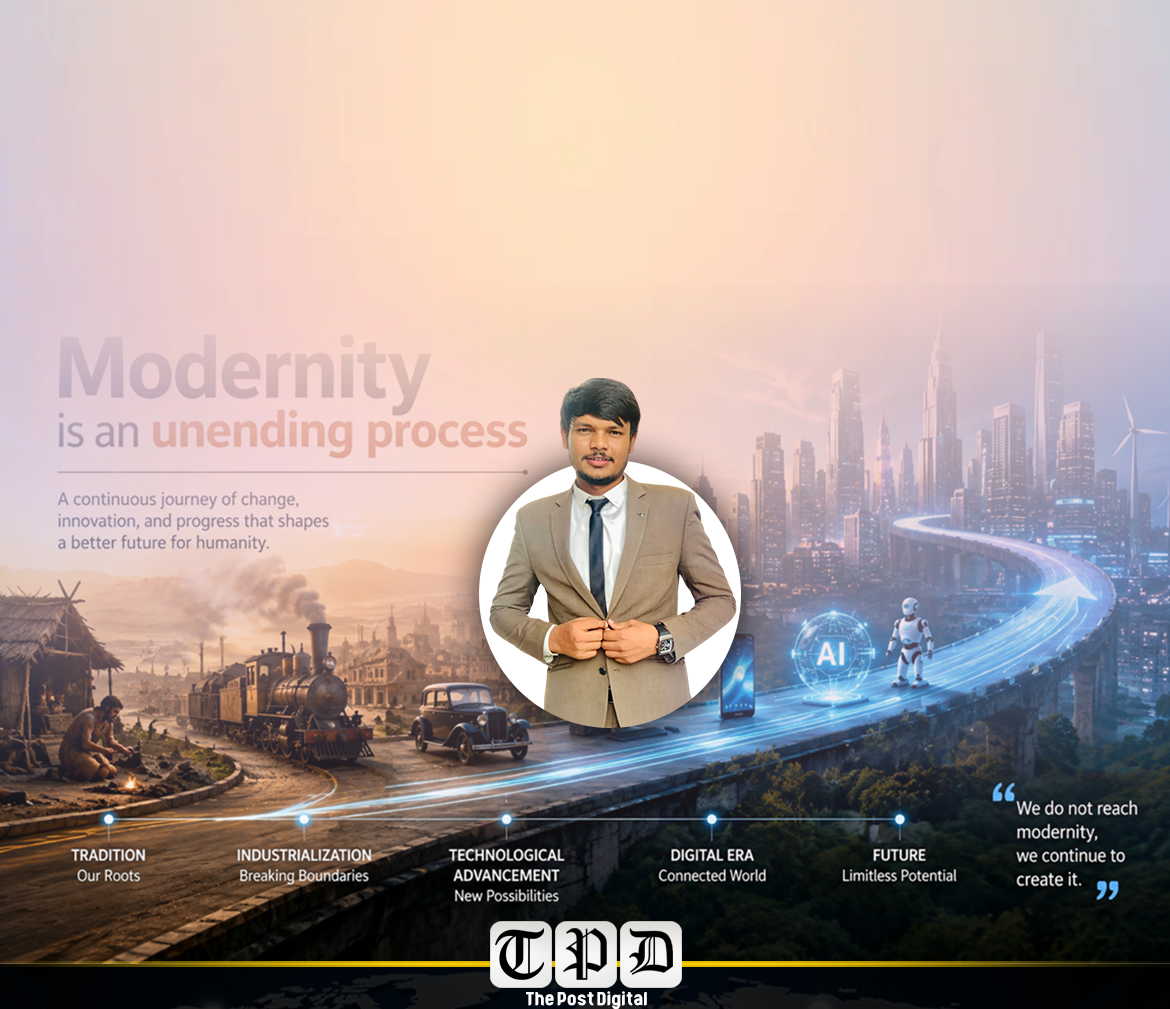
Yuval Noah Harari, in his book sapien: a brief history of mankind, asserts that the defining character of modernity is an ever-evolving and changing process. This signifies that modernity is not an ultimate stage but a non-stop development. New inventions, ideas and social-cum- structural transitions have always brought various changes in human life. From early primitive (stone age) to contemporary world, each era in human history has paved the way for change. When viewed through the lens of innovations, human history demonstrates that modernity has never been a final stage but constantly progressing process. In the stone age, stone tools, fires and cave art made it possible to survive and organise. In the Agriculture Age, cultivation, irrigation system, pastoralization and creation of village settlement allowed human beings to permanently populate and associate, which provided food and civilizational foundations. In the Bronze and Iron era, Bronze and Iron created tools, wheels and urbanization accelerated civilizational expansion as well as metallurgical. In the dark age, creation of mechanical clock, gunpowder weapon, and primarily printing press developed coordination, new war-front and widespread flow of knowledge. In the era of Renaissance and Enlightenment, scientific breakthroughs changed human perspective about Nature, universe and society. Industrialisation also played essential role in transforming the world through invention of steam engine, railways and electricity. In the same way, innovations of 20th century, such as automobiles, nuclear energy, TV and computer redefined human engagement and Geo political order. The 21st century: the age of artificial intelligence continues to re-shape its significance for the modern world. Therefore, modernity is never ending phenomenal process, in which every new creation paves the way for change and progressive era ahead.
In simple terms, modernity applies to structural.social change which, in process, transforms the traditional life through various forms of social, political, economic and cultural arrangements. Macionis, in his book sociology, affirms, "Modernity is social patterns resulting from industrialisation." This asserts that Industrial Revolution has been the very foundation for enhancing modernity and its roots in Europe. Human life, significantly, transformed due to various inventions of that era, particularly, the production of material goods.
Modernity is ever-evolving because of novel innovations, scientific breakthroughs and diffusion. With the passage of time, novel inventions created new things, ideas and social changes. In 1940, the spacecraft was developed through rocket propulsion research. That is why, one can easily make it to travel in space and explore it. The process of discovering new but existing things in the world made greater value towards strengthening modernity, such as exploration of continents and universe. The products are the results of Diffusion, people and information travel frequently from the one place to another. Max Weber, German sociologist, maintains “The spread of ideas is vital to modernization as the invention of those ideas.” The global spread of ideas alters the course of social traditions and pushes societies forward faster.
Charles Darwin quotes, “Survival of the fittest.” So was the mankind in its prehistoric era: the stone age. In this era, humans utilized stone-tools for their safety, fire and other respective uses. So, the invention of fire sowed the seed of survival and hopes for humans because the cooking of food was never applied before. Beside cooking, the humans used fire for their safety against wild animals and lightening at night. The creation of cave art was utilized in that era where humans had nothing to do as the work in the early age; therefore, they carved the caves for the protection from the various elements. They carved cave art through natural colors, simple but creative tools and techniques, i.e., finger painting. Thus, for the survival and social organisation, each development helped humans greatly.
The Agriculture Revolution: the neolithic era, was defined by the development of cultivation and irrigation system. During this era, equipment tools of Bronze and Iron, which facilitated human to cultivate and irrigate the fields effectively. Humans domesticated harmless animals and productive plants. The grown plants, included wheat, barley and rice while the domesticated animal included sheep, cattle, goats and horses. Humans were nomadic forager before agriculture, they wandered from place to place for hunting. However, after the timing of plants and animals, they developed settlements. Thus, they started building villages, towns and cities near rivers like Nile, Tigris and Indus. The developed towns and villages like Moen-jo-daro and Mahargarh, that established in the sub-continent.
The Bronze and Iron era also revolutionized and transformed modernity in human civilization. The Bronze era greatly contributed human technology. People unearthed copper and tin that generated an alloy: Bronze. The Bronze metal paved the wave for creating blades, daggers, arrow and spears, which were stronger and more reliable than stone-tools. Wheel, was also the result of bronze casting. Later, the iron era further enhanced the society, which expedited the creation of inexpensive and stronger equipments than bronze. Iron was vastly utilise in producing nails, utensils and more. In context of civilization evolution, people urbanised during this era. The began to develop villages, towns and cities for permanent settlements. Political systems and empires were also present there, i.e., Rome, Persia and Greece, further strengthing their civilization.
In the middle or Dark era, human life was transformed by various inventions. In the course of daily life, the circulation of paper through printing press made learning more feasible and invention of mechanical clock helped with organised time. Warfare was greatly in hands with the invention of gunpowder. The magnetic compass significantly facilitated people in finding directions. Therefore, the inventions of medieval era essentially facilitated coordination, new warfare and spread of knowledge. The period of Renaissance is also known as revival or rebirth of art, literature, knowledge and science. Human perspective of thinkings and observations was substantially changed. This period allowed many scientific breakthroughs by great scientist which altered the course of medicine and science knowledge. Copernicus deciphered that earth revolves around the sun. Kepler contributed to laws of planetary motion, and Harvey discovered blood circulation. However, Galileo Galilei, who emerged as the father of modern science, invented the telescope and outshined every other scientist of that era. Hence, the age of Renaissance altered the course of human perspective regarding Nature and Universe. The Industrial Revolution marked another decisive stage in the unending process of modernity. This era transformed every sphere of human life through revolutionary inventions and mechanised production. The invention of the steam engine by James Watt accelerated industrial production and transportation, while the Spinning Jenny of James Hargreaves revolutionized the textile industry by increasing manufacturing efficiency. The development of railways connected distant regions, promoted trade and facilitated the movement of people and goods at an unprecedented pace. Likewise, Thomas Edison invented the practical electric bulb which illuminated homes, factories and streets, extending productive hours beyond daylight. Factories expanded rapidly, urban centres emerged and economic activities flourished throughout Europe and later across the world. Therefore, industrialisation reshaped society by strengthening production, transportation and communication, laying a stronger foundation for modern civilization. The twentieth century further accelerated the process of modernity through remarkable scientific and technological innovations. The invention of automobiles transformed transportation by making travel faster and more convenient, while airplanes connected continents and revolutionized international trade, tourism and diplomacy. Nuclear energy introduced a new source of power and significantly altered global political and military relations. Television became a powerful medium for communication, education and entertainment, bringing information into every household. Likewise, the invention of computers revolutionized business, education, research and governance by processing information with greater speed and accuracy. The discovery of antibiotics, particularly penicillin, transformed medical science by preventing millions of deaths caused by infectious diseases. Thus, the twentieth century redefined human life through technological advancement, scientific discoveries and unprecedented global interconnectedness. The twenty first century continues the journey of modernity through rapid technological advancement and scientific discoveries. Artificial Intelligence has transformed the way people learn, work and communicate through platforms such as ChatGPT, Gemini and Meta AI. These intelligent systems assist in education, research, business and countless other fields, increasing efficiency and productivity. At the same time, genetic engineering has opened new possibilities in medicine and agriculture by improving disease treatment and developing resilient crops. Furthermore, the exploration of space has entered a new phase through reusable rockets, advanced satellites and missions to the Moon and Mars, expanding human understanding of the universe. Therefore, the present century demonstrates that modernity remains an unending process where every innovation creates new opportunities and shapes the future of humanity. In conclusion, modernity is an unending process because every age has introduced new inventions, discoveries and ideas that transformed human civilization. From the Stone Age to the Agricultural Revolution, from the Bronze and Iron era to the Renaissance and Industrial Revolution, every period has contributed to social, economic, political and scientific progress. Likewise, the twentieth and twenty first centuries continue this journey through revolutionary technologies and unprecedented innovations. As Yuval Noah Harari rightly argues, the only constant in modernity is change. Therefore, human civilization will continue to evolve through creativity, scientific advancement and continuous innovation, proving that modernity is not a final destination but a never ending process of transformation.
Pehlaj Kumar (Writer)