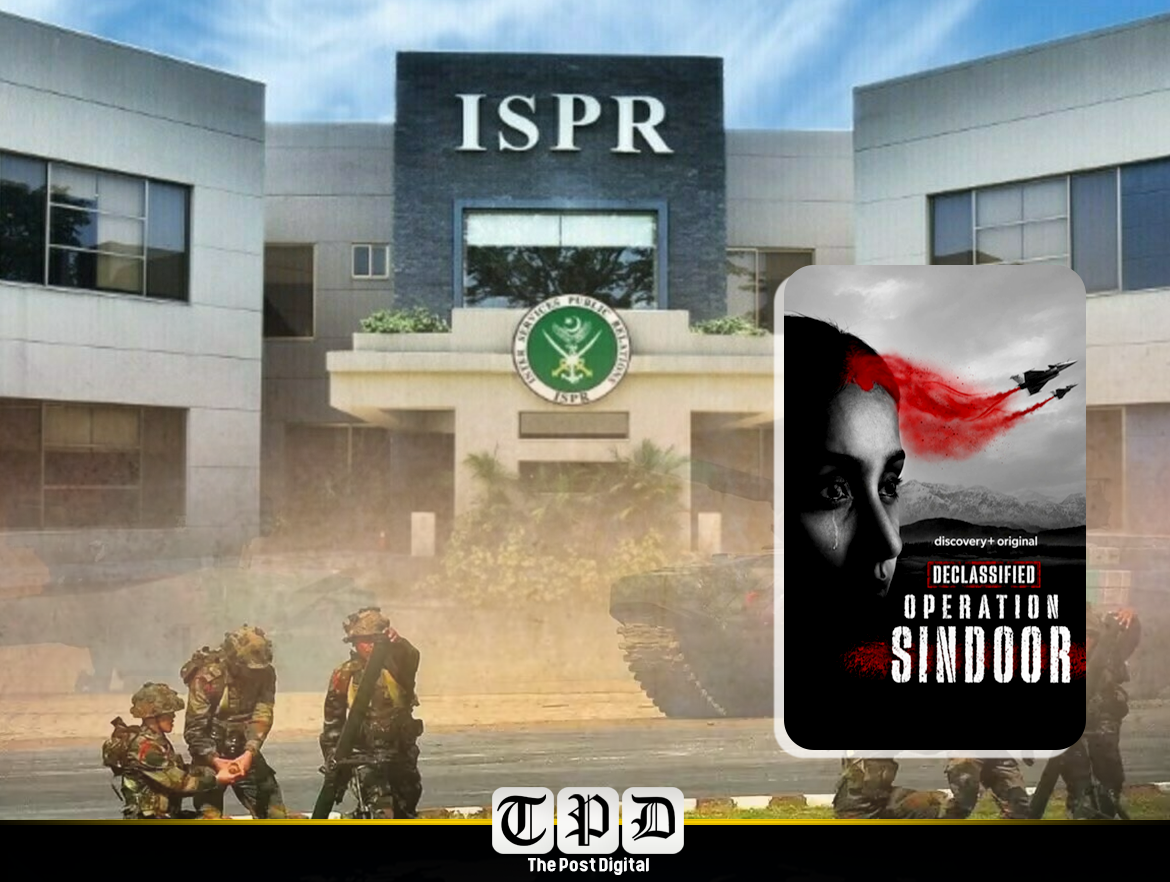
Rawalpindi: The Inter-Services Public Relations (ISPR) has issued a strong response to India’s recent documentary on “Operation Sindoor,” calling it an attempt to distort historical facts and portray military failure as success.
In a statement released on August 17, 2026, ISPR said that more than a year after “Marka-e-Haq,” India is still trying to reshape history according to its own narrative instead of accepting reality. The documentary, produced by Indian content creators, presents events through dramatic storytelling, emotional framing, and Bollywood-style visuals.
According to ISPR, the documentary attempts to reinterpret the outcomes of Operation Sindoor through selective interviews and factually inconsistent narratives, but contains several fundamental contradictions.
The statement noted that India described Operation Sindoor as action against those responsible for the Pahalgam incident, while according to India’s own claims, the three alleged suspects in the Pahalgam attack were killed on July 28, 2025, which is 82 days after Operation Sindoor. ISPR questioned: if the alleged perpetrators were killed on July 28, then who was India targeting on May 7?
ISPR also rejected India’s claim of “100% mission success,” stating that during Marka-e-Haq, Pakistan’s armed forces effectively responded to Indian aggression and shot down 8 Indian military aircraft.
The statement added that during Operation Bunyan-um-Marsoos, Pakistan targeted 26 military objectives using Fateh precision-guided rockets and missiles, Pakistan Air Force precision weapons, long-range loitering munitions, and precision artillery.
ISPR further said that Indian military leadership itself has acknowledged Pakistani missile, drone, and air activity, ongoing clashes along the Line of Control, and activation of India’s air defense systems—contradicting claims of a decisive Indian victory over Pakistan.
The statement also questioned the Indian narrative on the ceasefire, noting that even the documentary admits it was achieved through communication between the Directors General of Military Operations (DGMOs) of both countries and mutual agreement to halt military action. ISPR said the US-facilitated ceasefire cannot be portrayed as a unilateral Indian victory.
ISPR described the documentary as an attempt to present military failure as an acceptable national success story.
It added that no cinematic portrayal can change the realities of war, aircraft losses, military casualties, and actual battlefield engagements.
According to ISPR, Pakistan does not need any artificial narrative about Marka-e-Haq, as operational records, battlefield evidence, diplomatic communications, and even subsequent Indian statements themselves reflect the facts.
In conclusion, ISPR said Pakistan remains committed to regional peace and stability, but the armed forces are fully prepared and capable of defending national sovereignty, territorial integrity, and national interests. Any future military adventurism will be met with a strong and decisive response.